Understanding Hair Extension Quality: What to Look For Before You Buy

Extensions are one of those services where what you pay for really shows. Buy cheap and you'll know it within a month. Understanding a few key quality indicators before you commit saves a lot of frustration — and money — down the road.
Human hair vs. synthetic
The most basic distinction: human hair extensions behave like your own hair because they are hair. You can curl them, straighten them, colour them, and they blend naturally with your natural strands. They're more expensive, but for anything beyond a single special occasion, they're worth it.
Synthetic extensions are made from plastic fibers. They're affordable upfront, but they can't be heat styled (they'll melt), can't be coloured, and tend to have an artificial shine that reads as fake. They tangle more easily and wear out much faster. Fine for a costume or one event. Not practical for regular wear.
What "Remy" means and why it matters
Once you've landed on human hair, the next thing to understand is the term "Remy." It's not a brand — it describes how the hair was collected and processed.
Remy hair is harvested so that all the cuticles (the outermost layer of each strand) stay intact and run in the same direction, root to tip. When cuticles are aligned, the hair stays smooth, resists tangling, and holds up over time.
Non-Remy hair comes from multiple sources without that alignment, so the cuticles face every direction. To disguise this, manufacturers strip the cuticles off chemically, then coat the hair in silicone to make it feel smooth. It looks good in the store. The silicone wears off within weeks, and then you're left with hair that tangles, mats, and becomes difficult to manage. Always look for 100% Remy human hair.
Application methods
The method matters as much as the hair itself. The three most common options are:
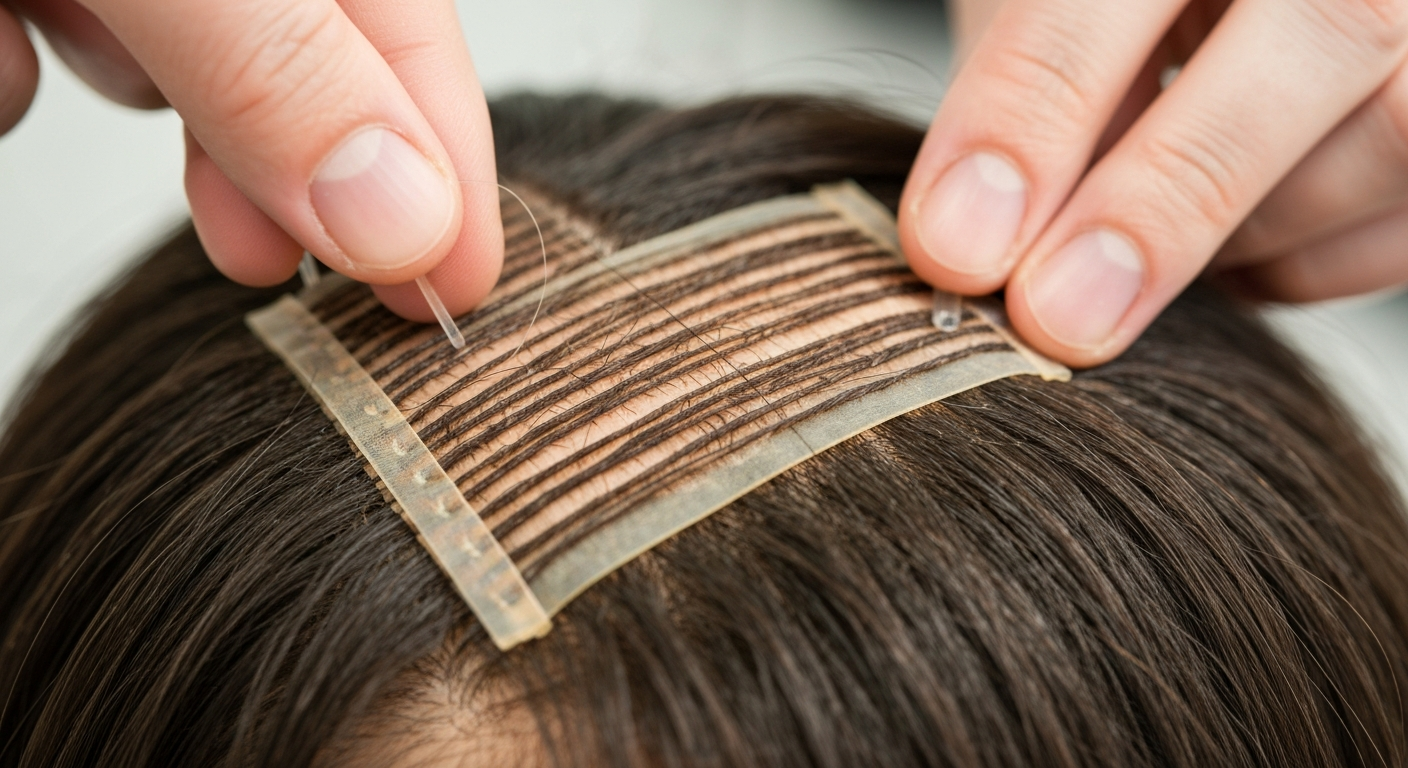
Tape-in extensions use a medical-grade adhesive to sandwich small sections of your natural hair between two wefts. They lie flat, feel lightweight, and look natural. Application is relatively quick compared to other methods. They need to be moved up every 6–8 weeks as your hair grows.
Micro-bead or I-tip extensions are applied strand by strand — no heat, no glue. A small silicone-lined bead threads through your natural hair, an extension strand is inserted, and the bead is clamped. They move naturally and allow more flexibility in styling. Adjustment is typically needed every 2–3 months.
Clip-in extensions are temporary wefts with clips that you put in and take out yourself. No salon application required for wear, and they're the most affordable option. Great for adding length or volume for an event, or for testing out extensions before committing to a longer-term method. Take them out before sleeping — leaving them in damages both the extensions and your natural hair.
How to evaluate quality before you commit
When looking at extensions, the signs of quality are fairly readable once you know what to check.
Good Remy human hair has a natural, healthy sheen — not a plasticky gloss. The colour looks consistent from root to tip. Run your fingers through the hair: it should glide smoothly without catching. If it feels waxy or stiff, that's likely a silicone coating masking lower-quality hair underneath. The ends should feel relatively full, not stringy or thin — a lot of budget extensions taper heavily at the bottom.
For tape and weft extensions, look at the bonding points. The hair should be evenly distributed across the weft with consistent density all the way down.
The longevity math
The cost difference between budget extensions and quality ones looks significant upfront. But synthetic extensions last a few days to a few weeks before they look worn. Low-grade non-Remy human hair might hold up for a month or two before the tangling becomes unmanageable. Quality Remy hair, with proper maintenance appointments, typically lasts six months to over a year. Clip-ins can last even longer since they're not worn daily.
Replacing cheap extensions repeatedly costs more in the long run, and low-quality extensions are harder on your natural hair. Professional installation is also part of the equation — improper application can cause breakage and thinning that takes time to recover from.
If you're thinking about extensions and want an honest assessment of what would work for your hair, come in for a consultation at European Hair Design at 2116 Pembina Hwy in Winnipeg. We'll look at your hair, talk through your goals, and give you a clear picture of your options.